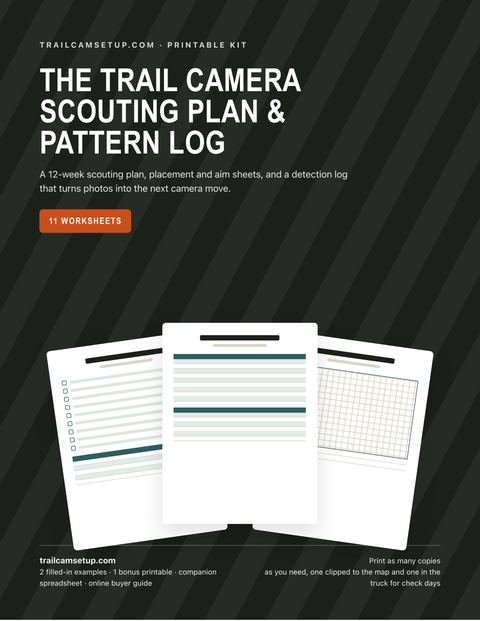
Set up the trail camera once, right.
Cellular or SD card, which data plan, how long the batteries last, what size card, and where to hang it. Calculators with the formula shown, and researched picks for three buyers: hunters scouting deer, wildlife watchers, and anyone guarding a cabin, gate or driveway.
Start with your buyer
Scouting deer
Cellular on the spots you need now, SD-card cameras everywhere else, and the state rules to check first.
WildlifeWatching wildlife
Video settings, low-glow range and cards big enough for behavior clips.
SecurityCabins, gates, driveways
No-glow, fast triggers, steel boxes, and when a 4G security camera is the better tool.
The calculators
All toolsCellular trail camera plan cost calculator
For one camera sending 250 photos a month for a 6-month season, SPYPOINT Basic and Tactacam Starter both cost about $30; under 100 photos a month the SPYPOINT free plan costs nothing.
CalculatorTrail camera battery life calculator
Eight lithium AAs in an SD-card camera at 20 triggers a day (half at night) last about 9 months; the same camera on alkaline AAs at 20F lasts about 2 months.
CalculatorTrail camera SD card size calculator
At 30 triggers a day of 20MP single photos, a 32GB card holds nearly 8 months; switch to 10-second 1080p video and the same card fills in about 7 weeks.
CalculatorTrail camera detection zone calculator
A camera with a 45-degree detection angle covers a strip about 33 feet wide at 40 feet; at 80 feet the same camera covers about 66 feet, if its sensor actually reaches that far.
CalculatorHow many trail cameras do I need?
A 160-acre property needs about 4 cameras for general scouting at one per 40 acres, or 2 for a deer population survey at the one-per-100-acres convention.
CalculatorDriveway and gate coverage check
A car at 15 mph crossing a 45-degree detection zone 25 feet from the camera is in the zone for about 0.9 seconds, so a 0.3-second trigger catches it and a 1-second trigger usually misses it.
What people buy
All roundups Cellular trail camera Moultrie Edge 3 Under $100
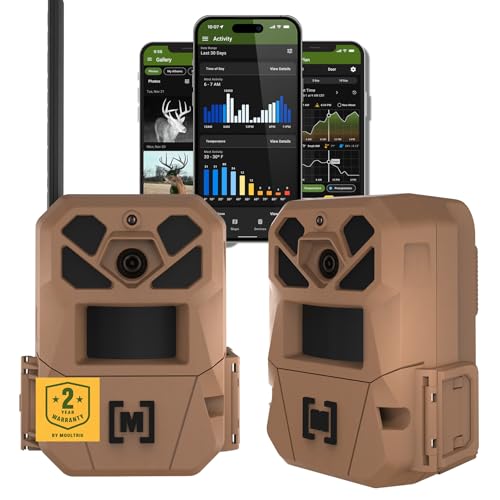
Best-selling cellular camera: 40MP, 0.5 s trigger, multi-carrier.
Specs and variants Check price Cellular trail camera SPYPOINT Flex-M Under $100
Free 100-photo plan: the cheapest way into cellular.
Specs and variants Check price SD-card trail camera GardePro E5S Under $50
No plan, no Wi-Fi, 0.1 s trigger. Just an SD card.
Specs and variants Check price Cellular trail camera Tactacam Reveal Ultra Under $150
Premium: 4K photos, live view, GPS.
Specs and variants Check priceBest gear by job
MoreThe best cellular trail cameras, by budget
Best cellular trail camera for most buyers: Moultrie Edge 3 (under $100). Plans run $0 to $15 a month; SPYPOINT has a free 100-photo tier. Compared by first-year cost.
RoundupThe best trail cameras for property security, subscription or none
The best trail cameras for cabins, gates, driveways, and farms, including no-glow SD-card options with zero monthly fee and cellular picks with a free plan.
RoundupThe best no-glow trail cameras
Best no-glow trail camera: Bushnell Core DS-4K No Glow (under $250). WOSPORTS 4K (under $100) is the budget pick; Moultrie Edge 3 Pro adds cellular alerts. 940 nm IR.
RoundupThe best trail cameras without Wi-Fi or cellular
The best non-cellular, non-Wi-Fi trail cameras that save to an SD card with no monthly fee, from an under-$50 beginner pick to a premium 46MP scouting camera.
RoundupThe best cheap trail cameras, all under $100
Best cheap trail camera: GardePro E5S (under $50, 0.1 s trigger). WOSPORTS Mini (under $25) is the cheapest usable pick; Stealth Cam Deceptor MAX is the best cellular under $100.
RoundupThe best solar trail cameras
The best solar-powered trail cameras for set-and-forget power, from the budget Moultrie Edge Solar to the premium SPYPOINT Flex-S Dark Solar and add-on panels.
Questions people ask
All guidesThe trail camera settings that actually matter
For most scouting setups, three photos per trigger, a 5 to 15 second trigger interval, medium sensitivity and short 1080p video clips gets useful data without filling the card or draining the battery in a few weeks.
GuideDoes a trail camera need Wi-Fi? No, and here is what each type needs instead
No. Most trail cameras save photos to an SD card and need no wireless connection at all; Wi-Fi models only need your phone nearby over a local hotspot, and cellular models use cell data instead of home Wi-Fi entirely.
GuideHow long do trail camera batteries actually last?
A standard SD-card trail camera on lithium AAs typically runs 6 to 12 months at normal trigger volume; a cellular camera sending photos over the network typically runs 1 to 4 months on the same batteries, because transmission drains far more power than saving to a card.
GuideCan trail cameras be used for home security? Yes, with real limits
Yes, a cellular trail camera can work as a basic security camera for a driveway, gate or cabin, sending photo alerts to your phone, but it lacks the continuous recording, faster push alerts and color night video that a dedicated security camera offers.
GuideWhat does no-glow mean on a trail camera?
No-glow means the camera uses roughly 940nm infrared LEDs that are invisible to people and most game at night, trading a bit of flash range and image sharpness for being completely covert, unlike a low-glow (roughly 850nm) or white-flash camera.
GuideWhat size SD card does a trail camera actually need?
Most trail cameras do fine on a 32GB SDHC card for casual use, but a 64GB or 128GB SDXC card is worth it for high-traffic spots, 4K video, or long stretches between checks; always check your camera manual's stated maximum card size first.
Look it up
Data plans compared
SPYPOINT, Tactacam, Moultrie, Stealth Cam and Bushnell at every photo count.
StorageSD card size, every case
By brand, by model and by capture mode and check interval.
PowerBattery life tables
Alkaline, lithium, NiMH and 12V at 5 to 200 triggers a day.
SettingsSettings by use
Mode, burst, delay and sensitivity for twelve jobs.
AcresCameras per acre
From 5 to 640 acres, scouting or survey.
ChartsReference charts
Plans, capacity, detection width, IR, file sizes, mounting angles.