How does a Wi-Fi trail camera work?

GardePro E6 2.0 Pro WiFi
$79.99 listed price, changes oftenWhat is a Wi-Fi trail camera?
A Wi-Fi trail camera creates its own local wireless connection, usually through a phone app, rather than sending photos over the cell network or requiring you to pull the SD card. The GardePro E6 2.0 Pro WiFi is a good example: it shoots up to 4K video and a native 64MP sensor, and pushes files straight to your phone over its own Wi-Fi hotspot instead of a router. There is no monthly plan involved at all, which is the main appeal versus a cellular camera.
How far does the Wi-Fi signal reach?
Listed range varies by model. The GardePro E6 2.0 Pro WiFi is rated to about 165 feet per the listing, the original GardePro E6 WiFi to about 45 feet, and the GardePro E6+ WiFi to about 75 feet. In practice, thick brush, hills and building walls all cut real-world range below the rated figure, so treat these as best-case numbers measured in open line of sight, not a guarantee at the far edge of your yard.
How is that different from a cellular trail camera?
| Wi-Fi trail camera | Cellular trail camera | |
|---|---|---|
| Monthly cost | $0 | $0 to $20/mo per camera |
| Range to your phone | About 45 to 165 ft, direct connection | Anywhere with cell signal |
| Needs a network | No, camera creates its own hotspot | Needs cell tower coverage |
| Good for | Backyard, garden, cabin porch, close food plot | Remote gate, back corner of a large property, security alerts |
See the full breakdown at Wi-Fi vs cellular trail camera.
Does a Wi-Fi trail camera need a home network or the internet?
No. Most Wi-Fi trail cameras, including the GardePro E6 line, broadcast their own local Wi-Fi signal that your phone connects to directly, the same way you would connect to a printer's Wi-Fi. That means it works with no router, no internet plan and no signal from a cell tower, but it also means you have to be standing within range to pull photos, which rules it out for a spot you cannot walk up to easily. Full detail at does a trail camera need Wi-Fi.
What drains the battery on a Wi-Fi trail camera?
The same triggers that drain any trail camera (night IR flash and video are the biggest draws) plus the act of transferring files over Wi-Fi itself, which pulls noticeably more power than simply writing to the SD card. A camera that gets checked and pulled from often, with the app open and transferring a batch of images each time, will run through batteries faster than the same camera left alone for weeks. Lithium AAs, covered in full in the battery life calculator, hold up far better under that load than alkaline.
Who should use a Wi-Fi trail camera instead of cellular?
Anyone watching a spot they walk past regularly anyway: a backyard feeder, a garden fence, a cabin porch, or a close food plot on a small property. There is no reason to pay a monthly cellular fee to check a camera you can walk up to in two minutes. Cellular earns its cost on a spot you cannot get to easily or where a same-day alert matters, like an unmanned gate or a remote back corner of a hunting lease.
What Wi-Fi trail cameras are worth buying?
The GardePro E6 2.0 Pro WiFi is the strongest all-rounder here with 4K video and the longest listed range in this lineup. The original GardePro E6 WiFi and the MAXDONE WiFi Bluetooth Trail Camera are budget options if 4K and long range are not priorities. The full roundup, including trade-offs by price, is at best Wi-Fi trail camera.
Gear mentioned in this guide
Listed prices change often; the button shows the current price.
 Wi-Fi / Bluetooth trail camera BoxLegend WiFi Trail Camera with 64GB card $39.99 Specs and variants Check price
 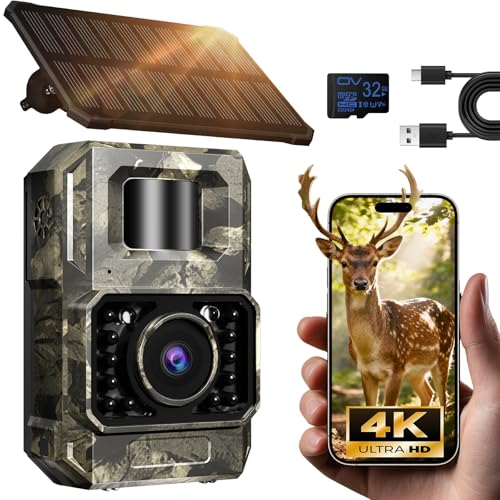 Wi-Fi / Bluetooth trail camera MAXDONE Solar WiFi Trail Camera (earlier model) $47.48 Specs and variants Check price
  Wi-Fi / Bluetooth trail camera MAXDONE WiFi Bluetooth Trail Camera $49.99 Specs and variants Check price
  Wi-Fi / Bluetooth trail camera MAXDONE Solar WiFi Bluetooth Trail Camera $59.99 Specs and variants Check price
 Frequently asked questions
Does a Wi-Fi trail camera need cell service?
No. A Wi-Fi trail camera creates its own local wireless signal that your phone connects to directly, so it works with no cell service and no home internet at all. That is also its limit: you have to be within the camera's Wi-Fi range, typically 45 to 165 feet depending on the model, to pull photos.
Can a Wi-Fi trail camera send photos to my phone automatically?
Only while you are connected to its signal and have the app open, on most consumer Wi-Fi trail cameras. Unlike a cellular camera, it does not push alerts to your phone from anywhere; you generally have to walk within range and open the app to pull new photos.
Is a Wi-Fi trail camera cheaper than cellular long term?
Yes, since there is no monthly data plan at all. The tradeoff is convenience: a cellular camera on a spot you rarely visit saves you the walk and gives same-day alerts, which a Wi-Fi camera cannot do beyond its short range.
What is a good range for a Wi-Fi trail camera?
Around 100 to 165 feet is strong for this category; the GardePro E6 2.0 Pro WiFi is rated near that figure. Anything under 50 feet, like the original GardePro E6 WiFi, is fine for a camera mounted close to a porch or feeder you walk past daily but is too short for most driveway or gate uses.
Does rain or trees weaken a Wi-Fi trail camera's signal?
Yes. The rated range on the listing is typically measured in open line of sight; thick brush, hills, tree trunks and buildings between the camera and your phone will all cut the effective range, sometimes significantly, so plan for less than the advertised number in wooded terrain.
Researched from published specifications, brand plan lists and verified owner reviews; we do not claim hands-on testing. General information, not professional, legal or security advice. Trail camera rules differ by state: some restrict transmitting cameras during hunting seasons or on public land, so check your state wildlife agency. Recording and audio laws vary; only record where you have the right to.