The best solar panels for a trail camera

Moultrie Solar Power Pack Gen 2 (3.4W)
$75.00 listed price, changes oftenPicks by experience level
Beginner
 Zonkasion 6V/12V solar panel, 5000mAh$29.99
A cheap universal 6V/12V panel that works across most trail camera brands rather than one specific model. It is a good first step up from batteries alone, but it is smaller and delivers less charging power than the brand-matched panels above it.
Check priceIntermediate
 SPYPOINT SPLB-10 solar panel with battery$59.99
SPYPOINT's own panel, built to plug directly into compatible SPYPOINT cellular cameras with no adapter needed. It is sized right for a single camera running through a normal season of cellular transmission.
Check priceExpert
 SPYPOINT SPLB-22 solar panel with battery$127.00
A larger panel built for cameras with heavy draw, like live view or frequent cellular sends, especially through short winter daylight. If your camera only uses SD card storage and gets checked every couple of weeks, skip solar altogether; a set of lithium AAs will outlast your check schedule for less money.
Check priceDoes a trail camera actually need a solar panel?
Not always. A camera checked every couple of weeks on SD card storage runs fine on lithium AA batteries alone; solar solves a different problem, which is running a camera continuously for a full season, especially one doing heavy cellular transmission, without ever swapping batteries. If you are checking a camera regularly anyway, save the money and put it toward a better battery. If you are leaving a camera out on a remote lease, a food plot you rarely visit, or a cabin driveway all season, solar removes the battery-swap trip entirely.
Brand-matched or universal solar panel, which is better?
A brand-matched panel, like SPYPOINT's SPLB series or Moultrie's Solar Power Pack, plugs straight into that brand's power port with no adapter and is sized to the camera's typical draw. A universal panel, like the Zonkasion or Aothaigro options, works across more brands using a generic barrel connector, but you have to confirm your camera's power port matches before buying. If your camera's brand sells its own panel, that is usually the simpler and more reliable choice; universal panels are the right call when your camera brand does not sell one, or when you are outfitting several different camera brands and want one panel style that fits most of them.
How much sun does a trail camera solar panel need?
These panels are built to trickle-charge through partly shaded canopy over the course of a full day, not to need direct all-day sun like a rooftop panel. A camera aimed at a food plot edge or a driveway usually gets enough exposure. A camera deep in thick timber facing north gets far less, and even a solar-assisted setup may still need a battery swap partway through winter when daylight is shortest. Pairing solar with lithium AA batteries, rather than relying on solar alone, gives the camera a buffer through stretches of overcast weather.
How do these solar panels compare?
| Panel | Fits | About | Best for |
|---|---|---|---|
| Zonkasion 6V/12V | Most brands (universal) | about $30 | Budget entry into solar |
| SPYPOINT SPLB-10 | Compatible SPYPOINT cameras | about $60 | One camera, standard use |
| Moultrie Solar Power Pack Gen 2 | Compatible Moultrie Edge cameras | about $75 | One Moultrie Edge camera |
| SPYPOINT SPLB-22 | Compatible SPYPOINT cameras | about $127 | Heavy cellular use, short winter days |
How we chose these picks
These picks come from published wattage, compatibility and price listed on each product's Amazon page, along with how owners describe pairing them with specific camera models in verified reviews. This is a research-based roundup, not a hands-on field test of charging performance in different light conditions.
Buying tips for a trail camera solar panel
Check your camera's power port and specifications before buying; a panel built for one brand's barrel connector will not necessarily fit another brand without an adapter, and not every camera even accepts external power. Mount the panel facing the clearest sky exposure available near the camera, angled to catch as much midday sun as the setting allows, even if that means it is not pointed the same direction as the camera lens. Do not treat solar as a replacement for good batteries; use lithium AAs alongside the panel so the camera has a buffer during stretches of clouds or heavy tree cover.
More picks worth a look
Listed prices change often; the button shows the current price.
Solar panel Moultrie Solar Power Pack Gen 2 (3.4W) $75.00 Moultrie's own solar power pack plugs directly into compatible Moultrie Edge cameras.
Specs and variants Check price Solar panel RISERO solar panel for Tactacam $43.99
 A panel built for Tactacam Reveal cameras, matched to that brand's power port.
Specs and variants Check price Solar panel Aothaigro universal trail camera solar panel $37.99
 A universal panel that mounts to most trail camera brands, a fallback if your camera does not have a brand-matched option.
Specs and variants Check price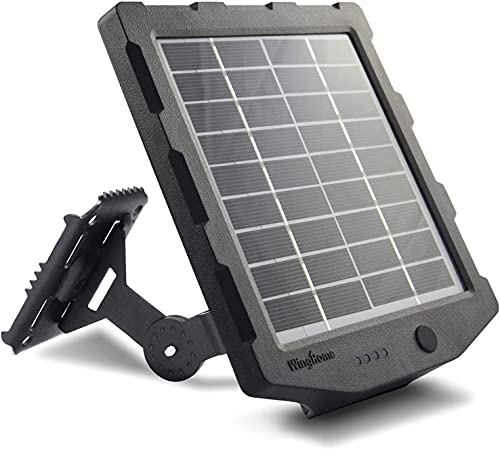 Solar panel WingHome 6V/12V solar panel kit $64.99
 A 6V/12V panel kit that includes its own mounting bracket, useful for posts or stakes without a nearby tree.
Specs and variants Check priceFrequently asked questions
Do trail camera solar panels really work?
Yes, for the problem they are built to solve: keeping a camera powered for a full season without a battery-swap trip, especially on cellular models with heavy transmission draw. They are not a substitute for good batteries in deep shade or short winter daylight, where a panel alone may not fully offset drain, so pairing solar with lithium AAs works better than solar alone.
Will any solar panel work with my trail camera?
Only if the panel's connector and voltage match your camera's power port, and only if your camera has an external power port at all. Brand-matched panels, like SPYPOINT's or Moultrie's own panels, are built to fit that brand's compatible cameras directly. Universal panels use a common barrel connector that fits many brands, but confirm compatibility before buying.
How long does a trail camera solar panel last?
Solar panels themselves have no moving parts and typically last for years outdoors, though connectors and cables are the more common failure point. The real question is whether the panel's output covers your camera's draw; a heavy cellular camera in deep shade may need a bigger panel or a battery backup to make it through a full season.
Does a solar panel replace batteries in a trail camera?
No, most trail camera solar panels trickle-charge the camera's existing batteries rather than running the camera directly, so you still need batteries installed. The panel's job is to top off those batteries during daylight so you are not swapping them out on every check, not to eliminate batteries from the setup.
Researched from published specifications, brand plan lists and verified owner reviews; we do not claim hands-on testing. General information, not professional, legal or security advice. Trail camera rules differ by state: some restrict transmitting cameras during hunting seasons or on public land, so check your state wildlife agency. Recording and audio laws vary; only record where you have the right to.